






When scaling an eCommerce business on Shopify, every merchant hits a fork in the road: should you install a pre-built app from the Shopify App Store, or invest in Shopify custom development? It is one of the most critical operational decisions you will make for your online store, directly impacting site speed, monthly operating expenses, user experience, and overall conversion rates.
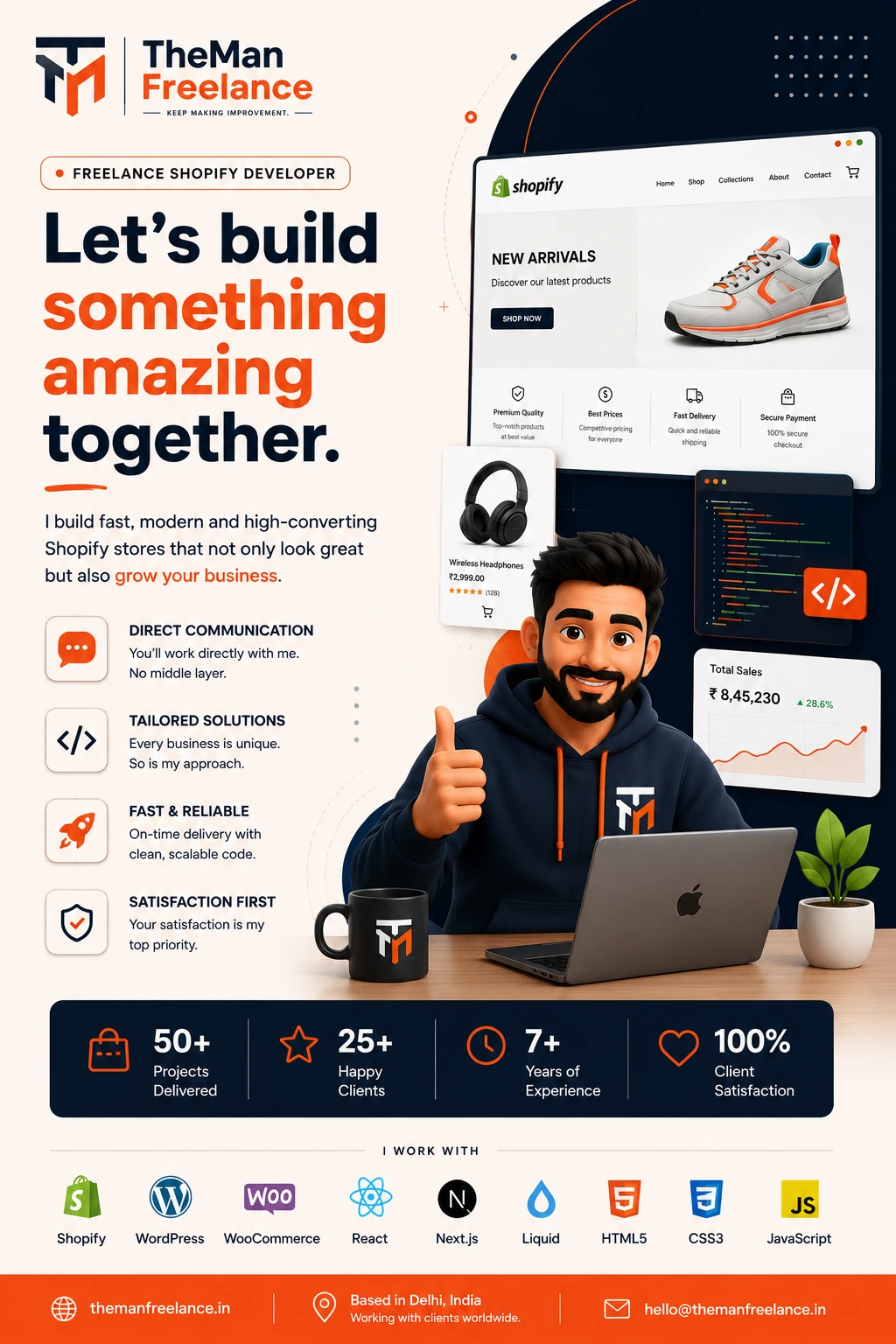
My name is Hemant, founder of Theman Freelance. Over the last 7+ years as an independent web developer, I have completed more than 150 projects across Shopify, WooCommerce, custom PHP, and React environments. I work directly with Shopify store owners, growing D2C brands, and digital agencies that require high-precision development without the unnecessary bloat and communication lag of traditional agencies. In this guide, I will break down Shopify apps vs custom development, giving you a practical, developer-tested framework to choose the right path for your business.
The Dilemma: Fast Plug-and-Play vs. Tailored Engineering
The core appeal of Shopify lies in its vast ecosystem. The Shopify App Store offers thousands of plug-and-play extensions promising instant solutions for upsells, subscriptions, loyalty points, and custom layout builders. For early-stage Shopify startups, apps are often an unbeatable entry point—allowing non-technical founders to launch competitive features within hours for a modest monthly fee.
However, as your store grows from hundreds to thousands of monthly transactions, reliance on third-party apps begins to reveal hidden trade-offs. What starts as a quick fix can evolve into a disorganized stack of competing scripts, recurring bills, and fragile workarounds. On the flip side, jumping straight into fully custom code without evaluating your actual business needs can consume working capital that might be better spent on inventory or customer acquisition.
Service Guarantees & Key Highlights
Custom Shopify Store Development
Build a custom Shopify store tailored to your products, brand identity, customer journey and eCommerce requirements. If Shopify is the right fit for your business, my freelance Shopify development service covers custom storefronts, theme work, integrations and performance improvements.
Shopify Theme Customization
Customize your Shopify theme with improved layouts, branded components and functionality designed around your store.
Shopify Liquid Development
Develop custom Shopify Liquid templates, sections and components for functionality beyond standard theme settings.
Shopify 2.0 Development
Build flexible Shopify Online Store 2.0 experiences using sections, templates and dynamic content for easier store management.
Shopify Store Redesign
Modernize an outdated Shopify store with improved visual design, navigation, mobile experience and conversion-focused UX.
Custom Sections & Blocks
Create reusable Shopify sections and blocks that give your team greater control over homepage, landing pages and product content.
Shopify Metafields & Metaobjects
Use Shopify metafields and metaobjects to create structured, dynamic product, collection and brand content.
Product Page Optimization
Improve Shopify product pages with better product information, media, variants, trust elements and conversion-focused layouts.
Collection & Navigation Optimization
Improve collections, menus, filters and product discovery so customers can find relevant products faster.
Shopify App & API Integrations
Connect Shopify with apps, external platforms and APIs to automate workflows and extend your store's functionality.
Custom Shopify Functionality
Develop custom Shopify features when existing themes or apps cannot provide the exact functionality your business needs.
Mobile-First Responsive Design
Create responsive Shopify storefronts that deliver a consistent and easy shopping experience across mobile, tablet and desktop.
Shopify SEO Optimization
Improve Shopify technical SEO, site structure, metadata, internal linking and product visibility for organic search.
Store Speed & Performance Optimization
Improve Shopify store performance by optimizing theme code, images, scripts and third-party app impact.
Conversion-Focused eCommerce UX
Improve the shopping journey through better product discovery, page layouts, trust signals and friction-free customer experiences.
Shopify Migration & Setup
Move your eCommerce business to Shopify with structured store setup, product migration and essential configuration.
Shopify Maintenance & Technical Support
Keep your Shopify store reliable with ongoing updates, troubleshooting, improvements and technical development support.
Core Challenges Faced by Scaling Shopify Merchants
When working with merchants who are stuck evaluating a Shopify app vs custom code approach, I consistently see three main technical and financial friction points:
1. The Hidden Cost of “App Bloat” and Monthly SaaS Fatigue
A $15 monthly app subscription sounds trivial. But as a store adds apps for social proof, custom bundles, back-in-stock alerts, search filters, and product add-ons, that monthly bill quietly balloons into $500 to $2,000+ per month. Worse yet, these are perpetual overhead expenses that never disappear. Over two to three years, a business often spends significantly more on cumulative subscription fees than it would have spent on a permanent, one-time custom code implementation.
2. Script Clutter and Site Speed Degradation
Every third-party app you install inserts external JavaScript files, CSS stylesheets, and tracking pixels into your store’s theme header. When a customer loads your product page, their browser must fetch assets from dozens of different external servers. This results in heavy render-blocking resources, slow Largest Contentful Paint (LCP) times, and degraded mobile performance. Because site speed correlates directly with conversion rates, an over-leveraged app stack often silently damages your revenue.
3. Code Conflicts and Unstable Theme Updates
Apps from different developers rarely test compatibility with one another. When two separate apps attempt to modify the native Shopify cart AJAX response or inject content into the same theme DOM element, unexpected bugs occur. Broken checkout flows, invisible dynamic buy buttons, and unstyled widgets are common symptoms of app conflicts—costing you lost sales and requiring urgent developer intervention anyway.
Deep-Dive Technical Strategy: What Custom Shopify Development Actually Looks Like
Choosing custom Shopify development does not mean reinventing the wheel or building a complex web application from scratch. Modern custom Shopify work focuses on leveraging platform-native tools to achieve elite performance and precise functionality.
Custom Shopify Liquid Development
Shopify’s native templating language, Liquid, is remarkably lightweight and flexible. By working directly within Shopify Liquid development standards, a skilled developer can build custom Shopify features directly into your theme’s section schemas. Features like tailored product accordions, custom bundle selector interfaces, tiered pricing highlights, and sticky mobile conversion bars can be hardcoded natively—eliminating external script calls entirely while giving your team easy drag-and-drop control inside the Shopify Theme Editor.
Unlocking Shopify Metafields and Metaobjects
Years ago, store owners relied on third-party app databases to display extra product specs, size charts, or complex layout elements. Today, Shopify’s native Metafields and Metaobjects allow us to structure complex dynamic data natively inside your store back-end. Whether you need structured ingredient lists, multi-field warranty matrices, or linked creator profiles, Metaobjects store this data natively inside Shopify. This data loads instantly without relying on external API calls or third-party server uptime.
Advanced Shopify API Integrations & Custom Functionality
When off-the-shelf apps cannot support your unique fulfillment rules, custom ERP workflows, or bespoke subscription logic, custom Shopify API integration bridges the gap. Utilizing Shopify’s Admin GraphQL API or Storefront API, custom middleware can synchronize data securely between your custom frontend and external business systems without adding frontend clutter for your shoppers.
Shopify Apps vs Custom Development: Side-by-Side Breakdown
To help guide your decision, here is how both approaches compare across key operational metrics:
- Speed to Market: Apps win for rapid prototyping. They install in minutes. Custom development requires initial scope design, testing, and implementation time.
- Store Performance: Custom code wins convincingly. Clean, native theme modifications add zero third-party latency. Apps add external HTTP requests and script overhead.
- Financial Model: Apps require ongoing monthly SaaS subscription payments. Custom development requires an initial capital investment, followed by lower, long-term maintenance costs.
- Ownership & Control: With custom development, you fully own your clean theme code and metadata structure. With apps, you are bound by the vendor’s roadmap, uptime, and potential price hikes.
- Unique Brand Experience: Pre-built apps look generic and often clash with your design system. Custom builds match your exact brand typography, spacing, and user interface design.
When Is a Shopify App the Better Option?
As a Shopify developer, I frequently advise clients to stick with an app when it makes practical financial sense. An app is usually the superior choice if:
- You are a early-stage merchant validating product-market fit with limited initial capital.
- You require heavy back-end processing or complex compliance engines, such as automated multi-state tax filing or international customs management.
- The feature is standard across eCommerce (e.g., standard customer review widgets like Judge.me or Okendo) where an app handles massive cloud infrastructure for image hosting and moderation.
When Does Custom Development Make More Sense?
Custom engineering becomes the clear winner when:
- Your core sales flow relies on a bespoke purchasing experience, such as a custom box builder, visual product configurator, or complex multi-tiered volume pricing.
- Your store speed has hit a ceiling, and technical audits reveal that third-party JavaScript scripts are destroying your mobile conversion rate.
- You are paying $500+ monthly for multiple basic apps whose core functionality can easily be coded permanently into your theme using native Liquid and Metafields.
- You are an agency needing specialized Shopify development services to execute a complex client design without relying on unreliable app builder plugins.
Practical Decision Checklist for Merchants
Ask yourself these four questions before making your choice:
- Is this feature a core visual/interactive part of our customer journey? If yes, consider custom build.
- How many active external app scripts currently load on our product pages? If more than 10, stop adding apps and start consolidating with custom code.
- What will this app cost us over 24 months in subscription fees? Compare that total against a one-time development project quote.
- Does an existing app require us to sacrifice our visual brand standards or UX guidelines? If yes, build it custom.
Real-World Insights from 150+ Projects
In my direct work with client stores at Theman Freelance, consolidating app stacks is one of the highest-ROI improvements we make. In one project for a scaling D2C apparel merchant, the store was running 16 distinct apps to handle minor features like size popups, notification bars, custom tabs, and bundle upsells. Their mobile performance score sat at 24/100, and their monthly app bill exceeded $750.
By replacing 9 of those lightweight apps with native Shopify Liquid development, custom styling, and native Metafields, we eliminated over 1.2MB of render-blocking JavaScript. The result? The store’s performance score jumped to 84/100, page load times dropped under 1.4 seconds, and monthly app expenses dropped significantly—paying off the initial custom development investment within six months while noticeably lifting conversion rates.
Actionable Takeaways & Next Steps for Your Store
You do not need to choose between an all-app setup or an all-custom setup. The most successful, fast-loading Shopify stores use a hybrid strategy: they rely on established apps for deep cloud-based infrastructure (like reviews or search indices) and use clean Shopify custom functionality for front-facing theme design, product options, and high-impact UX features.
If you want to evaluate your existing Shopify theme setup, reduce app debt, or build tailored features designed to scale, work directly with an experienced professional. At Theman Freelance as Shopify Freelance, you work directly with me—Hemant—ensuring clear technical direction, direct execution, and high-performance code built specifically for your store’s bottom line.
Ready to optimize your Shopify store? Reach out today for a practical, direct technical consultation and let’s explore the best roadmap for your business.